
Medicare Advantage Is Entering Another Major Shake-Up: What Agents Should Expect for AEP 2027
Carrier exits, tighter benefit strategies and a renewed focus on profitability are reshaping Medicare Advantage. For independent agents, the changes unfolding ahead of 2027 could make preparation more important than ever.
For much of the past decade, the Medicare Advantage story was defined by growth. Enrollment climbed, insurers entered new counties, benefit packages became increasingly competitive and Medicare beneficiaries in many parts of the country found themselves choosing among an expanding number of plans. As the industry prepares for 2027, however, a different story is beginning to take shape.
Some of the nation's largest Medicare Advantage insurers are taking a harder look at where they operate, what benefits they offer and whether individual markets can produce sustainable financial results.
That does not mean Medicare Advantage is disappearing. The program remains one of the largest and most important components of the Medicare system, serving tens of millions of beneficiaries.
What appears to be changing is the philosophy behind carrier expansion.
After years in which membership growth was frequently one of the industry's dominant objectives, insurers are increasingly emphasizing disciplined growth, sustainable benefits and profitability.
A Major Signal From One of Medicare Advantage's Largest Insurers
One of the clearest indications of the changing environment has come from Humana, one of the nation's largest Medicare Advantage organizations.
Recent company guidance and industry reporting indicate that Humana's 2027 Medicare Advantage strategy is expected to include plan and market exits affecting approximately 600,000 members, representing roughly 8 percent of its Medicare Advantage membership.
Humana has indicated that planned Medicare Advantage market and plan exits could affect approximately 600,000 members for the 2027 plan year.
The company expects that some affected members may remain with Humana by moving to other available Humana products. Even with that possibility, the scale of the planned changes is significant.
More importantly, the development should not be viewed solely as a Humana story.
Other Medicare Advantage organizations have also reassessed markets, reduced footprints, discontinued products or modified benefit strategies as insurers respond to rising healthcare utilization, reimbursement changes and pressure to improve Medicare Advantage margins.
That makes the larger trend considerably more important than the actions of any single insurance company.
Carriers appear increasingly willing to leave markets or discontinue plans that do not meet their financial and strategic objectives.
For agents who became accustomed to years of continuous Medicare Advantage expansion, that represents an important shift.
This Did Not Begin With 2027
The Medicare Advantage industry's pullback did not suddenly begin this year.
The signs have been visible across several plan years as carriers reconsidered geographic expansion and adjusted benefit packages in response to the changing economics of the program.
Beneficiaries in some markets have already experienced plan terminations, service-area reductions and fewer available plan options.
In certain areas, those changes have been substantial.
That does not mean beneficiaries no longer have meaningful Medicare Advantage choices. In many counties, competition remains strong and multiple carriers continue offering extensive plan portfolios.
But it does mean agents should no longer assume that the Medicare Advantage landscape they see today will automatically remain intact the following year.
The $13 Billion Question
There is an apparent contradiction at the center of the 2027 Medicare Advantage story.
In April 2026, the Centers for Medicare & Medicaid Services finalized the Calendar Year 2027 Medicare Advantage and Part D Rate Announcement.
According to CMS, the finalized policies are projected to result in an average 2.48 percent increase in Medicare Advantage payments for 2027, representing more than $13 billion in additional payments to Medicare Advantage plans nationwide compared with the prior year.
CMS projects that finalized 2027 policies will result in more than $13 billion in additional Medicare Advantage payments nationwide.
CMS has also estimated that when expected Medicare Advantage risk-score trends are incorporated, the average overall change in payments could be approximately 4.98 percent.
At first glance, those numbers might appear difficult to reconcile with insurers simultaneously reducing their presence in some markets.
If Medicare Advantage organizations are receiving billions of dollars in additional projected federal payments, why would plans still leave counties or reduce benefits?
The answer lies in the complexity of Medicare Advantage economics.
A National Payment Increase Does Not Make Every Plan Profitable
A Medicare Advantage organization does not operate one enormous national insurance plan.
Its financial results can differ dramatically from one contract, county and plan to another.
Healthcare utilization may be significantly higher in one region. Provider contracting costs may be more expensive in another. Membership may be too limited to produce sufficient scale elsewhere.
Prescription drug expenses matter.
Risk adjustment matters.
Star Ratings matter.
Supplemental benefits cost money.
Hospital utilization, specialist care, provider reimbursement arrangements and the overall health characteristics of a plan's membership can all influence financial performance.
A nationwide increase in federal Medicare Advantage payments therefore does not automatically make every individual plan or service area financially attractive.
That helps explain why the industry can receive substantial additional federal funding while individual carriers simultaneously decide that particular markets no longer fit their long-term strategy.
It is becoming: "Can we grow here profitably and sustainably?"
Benefit Pressure May Be Just as Important as Carrier Exits
Carrier withdrawals tend to attract attention because they are easy to recognize.
A plan exists one year and disappears the next.
But some of the most important changes affecting Medicare beneficiaries may occur inside plans that remain available.
A Medicare Advantage plan does not need to leave a county for its value proposition to change substantially.
An insurer can redesign cost sharing.
A supplemental benefit can be reduced.
A provider network can change.
Prescription formularies can change.
A preferred pharmacy relationship can change.
Copayments for specialists, hospitals or other medical services can increase or decrease.
Supplemental benefits such as dental, vision, hearing, fitness, transportation and over-the-counter allowances have become highly visible components of Medicare Advantage competition.
For years, richer supplemental benefits helped carriers differentiate plans in increasingly crowded markets.
But those benefits have a cost.
As insurers focus more heavily on sustainable margins, agents should be prepared for the possibility that some Medicare Advantage plans will remain available in 2027 while looking noticeably different from their 2026 versions.
Sometimes the plan stays. What changes is the plan itself.
The Most Important Piece of Medicare Mail This Fall
Every year, Medicare Advantage and Part D members receive an Annual Notice of Change, commonly referred to as the ANOC.
And every year, some beneficiaries barely look at it.
That may be an especially risky habit heading into the 2027 plan year.
The Annual Notice of Change explains important changes that will take effect during the upcoming calendar year.
Depending on the plan, those changes can affect premiums, deductibles, copayments, coinsurance, supplemental benefits and other aspects of coverage.
For a beneficiary who has remained satisfied with the same Medicare Advantage plan for several years, it can be tempting to assume that no action is necessary.
That assumption deserves greater scrutiny in a changing Medicare Advantage market.
A plan that worked extremely well for a beneficiary in 2026 may continue to be the appropriate choice for 2027.
But that should be confirmed rather than presumed.
AEP 2027 May Reward Preparation More Than Advertising
Every Annual Enrollment Period produces an enormous amount of marketing.
Television advertisements multiply. Mailboxes fill. Digital campaigns intensify. Call centers increase staffing. Agents compete for appointments.
But AEP 2027 may reward something considerably less visible.
Preparation.
The agents who understand what is happening inside their existing books of business before October 15 may be better positioned than those who wait for client calls to begin.
Carrier certifications should be completed.
Contracting relationships should be confirmed.
Agents should understand the carrier portfolio available to them.
Client contact information should be current.
Existing books of business should be organized so beneficiaries affected by significant changes can be identified efficiently once final 2027 plan information becomes available.
The goal should be to enter AEP understanding the market rather than attempting to learn it while appointments are already happening.
Agents Should Be Prepared to Answer One Question: What Changed?
For many existing Medicare clients, the most important conversation during the upcoming AEP may begin with two words:
What changed?
That question can lead to several others.
Did the monthly premium change?
Did the maximum out-of-pocket amount change?
Are the client's physicians and specialists still participating?
Are the client's prescriptions still covered appropriately?
Did hospital or specialist copayments change?
Were supplemental benefits reduced, increased or redesigned?
Did the carrier change its preferred pharmacy relationships?
Is another plan now more appropriate based on the client's individual healthcare needs?
Those questions require more than quickly comparing benefit summaries.
They require understanding the client.
Independent Agents May Become More Important, Not Less
There is an interesting consequence when a healthcare market becomes more selective.
Fewer plans do not necessarily make decisions easier.
Sometimes they make professional guidance more important.
Consider a Medicare beneficiary who has remained with the same carrier for six years.
The doctors are familiar. The pharmacy arrangement works. The member understands the copayments. The plan has simply become part of everyday life.
Then a letter arrives.
The plan will not be offered the following year.
Suddenly that beneficiary must evaluate alternatives that may be unfamiliar.
Which plan includes the beneficiary's physicians?
Which plan appropriately covers the medications?
What could hospital care cost?
What is the maximum out-of-pocket exposure?
How important are the supplemental benefits?
Does another Medicare Advantage plan make sense?
Should other Medicare coverage options be evaluated?
Those are no longer abstract insurance questions.
They are decisions about someone's healthcare.
That is where knowledgeable independent agents have an opportunity to demonstrate their value.
The Best Plan Is Not Necessarily the Plan With the Biggest Benefit
Medicare Advantage competition has increasingly focused public attention on supplemental benefits.
Dental.
Vision.
Hearing.
Fitness.
Over-the-counter allowances.
Transportation.
Additional benefits for qualifying members.
Those benefits can provide meaningful value.
But they should never become a substitute for evaluating the entire health plan.
A $0 premium plan may not be the best plan for every beneficiary.
The plan advertising the largest dental allowance may not include the beneficiary's preferred physicians.
A generous supplemental allowance may matter much less to someone than continued access to a particular cardiologist, oncologist, hospital system or medical group.
Prescription drug coverage can completely change the financial equation.
So can maximum out-of-pocket exposure.
The strongest Medicare agents understand this distinction.
They begin with: "What does this client actually need?"
Provider Networks Could Matter More Than the Advertisement
Provider networks remain one of the most important elements of any Medicare Advantage comparison.
A beneficiary may be attracted to a plan because of a particular premium or supplemental benefit, only to discover that a physician, specialist, medical group or hospital system important to the member does not participate.
Networks also change.
Physicians can change affiliations.
Medical groups can change carrier relationships.
Hospitals renegotiate agreements.
Agents should therefore avoid relying solely on what was true during the previous plan year.
Provider participation should be reviewed using current information when making recommendations.
The same principle applies to prescription drug coverage and pharmacy networks.
A pharmacy may participate with a plan while another pharmacy is preferred and offers considerably lower prescription costs.
For beneficiaries taking multiple medications, those differences can have a meaningful impact on annual healthcare spending.
Carrier Diversification Is Becoming Business Protection
The changing Medicare Advantage market also carries an important lesson for agents themselves.
Depending too heavily on a single carrier has always created business risk.
That risk is becoming increasingly visible.
A carrier can exit a county.
A product can be discontinued.
A plan can become less competitive.
A compensation structure can change.
A provider network can change.
A benefit that helped drive enrollments during one AEP can look very different the following year.
The writing agent controls none of those decisions.
That makes carrier diversification more than a sales strategy.
It is business protection.
An independent agent with access to a broad portfolio is better positioned to continue serving clients when market conditions change.
If one carrier exits, the client's relationship with the agent does not have to disappear with it.
If one product becomes less competitive, the agent can evaluate alternatives.
The client relationship can last for decades.
That may ultimately be one of the most important competitive advantages independent agents have in a changing Medicare marketplace.
Medicare Advantage Is Not Collapsing
It is equally important not to exaggerate what is happening.
Medicare Advantage remains enormous.
Approximately 35.5 million Americans were enrolled in Medicare Advantage in 2026, representing roughly half of the overall Medicare population.
Medicare Advantage continues to serve tens of millions of Americans and remains one of the largest segments of the U.S. health insurance market.
CMS continues to direct substantial federal funding into the program, and carriers continue to compete aggressively in many markets.
This is not a story about Medicare Advantage disappearing.
It is a story about Medicare Advantage maturing.
For years, rapid expansion was one of the defining characteristics of the program.
Now the industry is confronting many of the challenges that come with enormous scale: healthcare utilization, reimbursement, provider costs, benefit sustainability and profitability.
The next phase of Medicare Advantage could involve fewer marginal markets, more disciplined benefit design and greater attention to the financial performance of individual products.
Some markets will remain extraordinarily competitive.
Some carriers may continue expanding in selected areas.
Other markets could contract.
The Medicare Advantage map will not move uniformly in one direction.
That is precisely why agents need to pay attention.
Medicare Advantage Remains Highly Local
National headlines can provide important context, but Medicare Advantage remains fundamentally local.
A carrier can reduce its overall national footprint while remaining highly competitive in certain states or counties.
The opposite can also occur.
A company may expand into a new region while simultaneously reducing exposure somewhere else.
That means agents should be careful not to interpret national announcements as though they automatically describe their local marketplace.
Service areas matter.
County-level plan availability matters.
Provider networks matter.
Specific plan contracts matter.
And ultimately, individual beneficiary circumstances matter.
The Medicare Advantage experience of an agent working in Los Angeles County can look very different from that of an agent in Phoenix, Las Vegas, Houston, Miami or another market.
The strongest Medicare professionals understand the markets where they actually conduct business.
We Still Do Not Know the Complete 2027 Picture
There is another important point that should not be lost amid the headlines.
It is August.
The complete 2027 Medicare Advantage landscape is still developing.
Not every carrier decision has been publicly announced, and the complete county-by-county competitive picture will become clearer as final plan information becomes available.
Agents should therefore avoid making assumptions based solely on preliminary industry announcements.
A national headline does not tell an agent exactly what will happen in a particular county.
A carrier reducing its overall footprint does not mean it is leaving every market.
And a company exiting certain plans does not necessarily mean every member currently enrolled with that company will need to choose another carrier.
August 2026: Agents should focus on certifications, contracting, organization and general AEP preparation while monitoring carrier announcements.
October 1, 2026: Marketing of prospective 2027 Medicare Advantage and Part D plan offerings may begin under applicable Medicare rules.
October 15, 2026: The Medicare Annual Enrollment Period begins.
December 7, 2026: The Medicare Annual Enrollment Period ends.
Specific plan information matters.
Specific service areas matter.
Specific clients matter.
The coming weeks will provide considerably more clarity.
What Agents Can Control Right Now
Agents cannot control carrier strategy.
They cannot control CMS reimbursement.
They cannot control healthcare utilization.
They cannot control whether an insurer decides that a particular county still fits its long-term business strategy.
But there is a great deal agents can control.
They can complete required certifications early.
They can maintain access to a diverse carrier portfolio where appropriate.
They can organize their existing books of business.
They can verify client contact information.
They can establish annual review workflows.
They can strengthen their understanding of plan structures, provider networks and prescription coverage.
They can prepare processes for identifying clients affected by significant changes once 2027 plan information becomes available.
And they can make sure clients understand something important before the flood of AEP advertising begins:
Their agent is still there.
That message may ultimately be more valuable than another advertisement.
Retention Could Be as Important as New Enrollment
The changing Medicare Advantage environment is also a reminder that AEP should never be viewed solely as a season for finding new clients.
It is one of the most important retention periods of the year.
Agents spend years building relationships and books of business.
Existing clients should not be forgotten while new prospects receive all the attention.
A proactive annual review allows an agent to explain changes, evaluate whether physicians and prescriptions remain appropriately covered and determine whether the client's existing plan continues to make sense.
Sometimes the appropriate recommendation will be to change plans.
Sometimes the appropriate recommendation will be to remain exactly where the beneficiary is.
Trust is built when clients understand that the recommendation is based on their needs rather than the desire to create another transaction.
AEP 2027 Could Be a Test of the Independent Agent Model
Annual Enrollment Period is often described as a sales season.
That description may not fully capture what will be required from agents in 2027.
This AEP could become a test of which agents have built genuine advisory practices and which have simply built enrollment pipelines.
When plans change, beneficiaries need explanation.
When carriers exit, they need alternatives.
When benefits are reduced or redesigned, they need perspective.
When an advertisement promotes an attractive benefit, beneficiaries need someone willing to examine the rest of the plan.
And when the appropriate answer is that the client's existing coverage remains a strong fit, a professional agent should be willing to say that too.
Technology Will Help, but It Will Not Know the Client
Technology will continue to make Medicare plan comparison faster.
Quoting platforms can compare premiums, prescriptions, pharmacies, plan benefits and estimated costs with tremendous efficiency.
Consumers also have access to more information than at any previous point in Medicare's history.
Artificial intelligence will make information easier to retrieve.
Online enrollment will become increasingly familiar.
Those developments do not eliminate the value of a knowledgeable professional who understands the individual sitting across the table.
A computer can compare premiums.
A website can display benefits.
An advertisement can promote an allowance.
But those tools do not automatically understand that keeping a longtime cardiologist may be one client's highest priority.
They do not inherently know that one prescription could make an otherwise attractive plan a poor financial choice.
They do not understand a beneficiary's concerns until someone asks the right questions.
And they do not replace the trust developed by an agent who has helped the same family navigate Medicare decisions year after year.
In a complicated market, that relationship can become more valuable rather than less.
The Market Is Sending Agents a Message
The Medicare Advantage industry entering 2027 looks different from the market many agents became accustomed to during years of rapid expansion.
Carrier exits are increasingly part of the conversation.
Benefit sustainability is receiving more scrutiny.
Healthcare utilization remains a major consideration.
Profitability has moved to the center of carrier strategy.
At the same time, tens of millions of Americans continue to depend on Medicare Advantage for their healthcare coverage.
Those realities are not contradictory.
Medicare Advantage can remain a strong and important component of Medicare while individual insurers become more selective about where and how they participate.
For agents, the lesson is straightforward.
The fact that a plan existed last year does not guarantee it will exist next year.
The fact that a benefit was available last year does not guarantee it will remain unchanged.
The fact that a client was satisfied last year does not eliminate the need for a thoughtful review this year.
The Most Valuable Question This AEP
AEP 2027 may require more from Medicare agents than simply knowing which carrier offers the newest supplemental benefit.
Agents will need to understand what changed, why it matters and what alternatives are available when those changes affect a beneficiary.
That requires preparation.
It requires broad carrier knowledge.
It requires accurate plan comparison.
It requires understanding provider networks and prescription coverage.
Most importantly, it requires knowing the client.
When October 15 arrives, perhaps the most valuable question an independent Medicare agent can ask will not be:
"What can I enroll this client into?"
It may instead be:
"What changed for this client, and what is the best decision for them now?"
The agents who can answer that question well will be prepared for whatever the 2027 Medicare Advantage market brings.
Advantage Plus Is Preparing for AEP 2027
Advantage Plus Insurance Agency is closely monitoring carrier participation, certifications, plan availability and developments across the 2027 Medicare Advantage market. Our focus is to provide independent insurance professionals with the carrier relationships, resources, technology, training and operational support needed to adapt as the market changes and continue serving Medicare beneficiaries effectively.
Sources & Further Reading
Centers for Medicare & Medicaid Services — 2027 Medicare Advantage and Part D Rate Announcement
CMS 2027 Medicare Advantage and Part D Rate Announcement
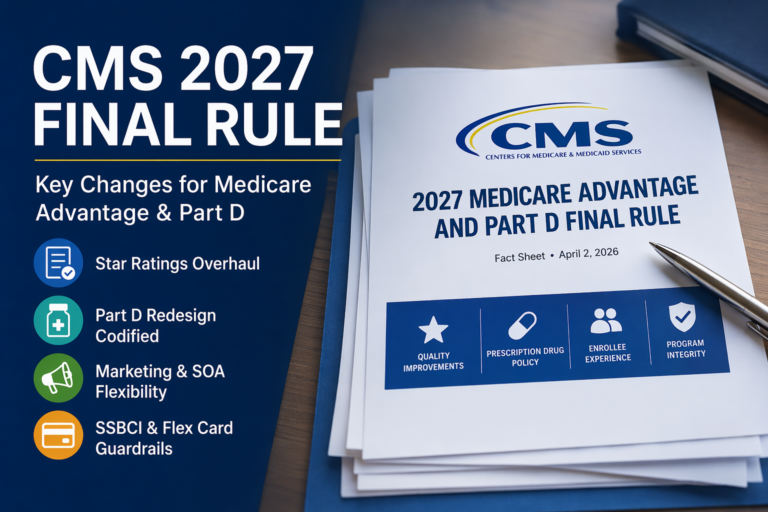
Centers for Medicare & Medicaid Services — Contract Year 2027 Medicare Advantage and Part D Final Rule
CMS Contract Year 2027 Medicare Advantage and Part D Final Rule
Humana — Investor Relations and 2026 Financial Reporting
Humana Investor Relations
MarketWatch — Medicare Advantage Carrier Exit Reporting
Medicare Advantage Market Exit Coverage
Disclaimer: This article is intended for general educational and informational purposes for insurance professionals. It does not constitute legal, compliance, tax or individualized coverage advice. Medicare Advantage and Part D premiums, benefits, formularies, provider networks, service areas and plan availability vary by plan and location and may change annually. Agents should rely on current CMS guidance, approved carrier materials and applicable state and federal requirements when discussing Medicare products.
Ready To Grow Your Medicare Business The Right Way?
Join Advantage Plus and plug into a system built for serious Medicare agents with contracts, training, compliance support, marketing resources, and tools to grow the right way.