

For years, Medicare carriers have aggressively marketed themselves as “broker friendly.” The phrase appears everywhere across the industry. It is used in conferences, agent recruiting campaigns, broker manager presentations, sales trainings, webinars, and annual kickoff events. Carriers emphasize relationships with agents and agencies as if brokers are truly viewed as long term partners in the Medicare ecosystem.
But behind the branding and public messaging, a growing number of agents are beginning to ask a difficult question.
What if some of the same organizations promoting themselves as broker friendly are quietly benefiting from systems and loopholes that actively harm both beneficiaries and agents behind the scenes?
The issue is no longer simply about commissions. It has become a much larger conversation about ethics, beneficiary protection, accountability, and whether certain internal enrollment practices are creating incentives that contradict the public image these organizations present to the broker community.
One of the biggest examples involves short term disenrollments and the handling of Agent of Record assignments during reinstatements.
Across the Medicare industry, there has been a sharp rise in situations where beneficiaries are enrolled into a plan, quickly disenrolled, and then later returned to the exact same plan within a short period of time. In many of these cases, the member never intended to permanently leave the original plan in the first place. Some disenrollments are caused by confusion. Others stem from unauthorized marketing activity, misleading enrollments, aggressive call center tactics, third party lead vendors, or enrollment manipulation that beneficiaries often do not fully understand until after the damage is already done.
When the beneficiary realizes what happened, they frequently contact Medicare, file complaints, and request to return to their original plan.
On the surface, carriers often position themselves as doing the right thing by allowing the member to come back. Internally, however, a very different process can occur.
The member may be reinstated into the exact same plan they originally had, with the same doctors, same network, same benefits, and same continuity of care. Yet despite the member returning to the same coverage, the original Agent of Record is often removed entirely during the reinstatement process. In many situations, the policy is reassigned internally to a house account or to another broker relationship tied to backend enrollment structures.
What makes this issue particularly controversial is that many carriers simultaneously maintain strict front end protections that prevent direct Agent of Record changes under normal circumstances. Agents are routinely told that AOR protections exist to prevent poaching, protect compliance, and maintain enrollment integrity. Front facing systems are often designed specifically to make AOR changes difficult or restricted.
Yet somehow, through short term disenrollment and reinstatement scenarios, those same protections appear to disappear on the backend.
The result creates what many agents now view as a contradiction.
Carriers publicly present themselves as protecting brokers while internally allowing systems that can ultimately strip brokers of their clients during reinstatement workflows.
The financial implications are significant, but the beneficiary impact may be even more concerning.
When a beneficiary is disenrolled from a Medicare Advantage plan, even temporarily, the disruption can create serious problems. Deductibles may reset. Prior authorizations can disappear. Prescription access can become interrupted. Provider access can change unexpectedly. Claims can become delayed or denied. In certain cases, vulnerable seniors are left confused about whether they still have active coverage while medical services are already in progress.
Many beneficiaries do not fully understand what happened until they attempt to access care.
The disruption is especially damaging for seniors managing chronic conditions, specialist treatments, hospital coordination, or ongoing medication needs. Even a short lapse in continuity can create real health risks.
Despite these realities, critics argue that the current system unintentionally rewards instability.
A short term disenrollment can create opportunities for backend reassignment of the membership while the carrier still retains the member itself. In other words, the plan keeps the enrollment relationship and membership numbers while the original broker relationship disappears.
This is where the conversation becomes uncomfortable for the industry.
Because if carriers truly believed that the original broker relationship mattered, many agents argue there would already be standardized safeguards preventing these short term resets from impacting the original Agent of Record.
Instead, the absence of consistent protections has created growing suspicion throughout the broker community that membership retention may ultimately be prioritized over broker integrity.
Industry insiders privately acknowledge that member retention metrics, plan growth numbers, and internal distribution relationships carry enormous financial value for carriers. Every retained membership impacts revenue, market share, investor performance, star ratings influence, and long term organizational growth. In highly competitive Medicare markets, maintaining membership counts has become one of the industry’s most important objectives.
That reality creates tension between what is publicly marketed to brokers and what may actually occur operationally behind closed doors.
Some carriers have attempted to frame these situations as technical enrollment limitations or compliance driven system restrictions. Others argue that reinstatement scenarios are complex and require internal handling standards. But agents across the country increasingly believe the issue is no longer isolated or accidental.
The patterns are becoming too frequent.
More importantly, agents argue the issue exposes a deeper flaw within the Medicare ecosystem itself. The industry has spent years promoting broker relationships while simultaneously building structures where those relationships can quietly disappear through backend administrative processes that beneficiaries themselves often never even understand.
This is precisely why calls for reform are beginning to grow louder.
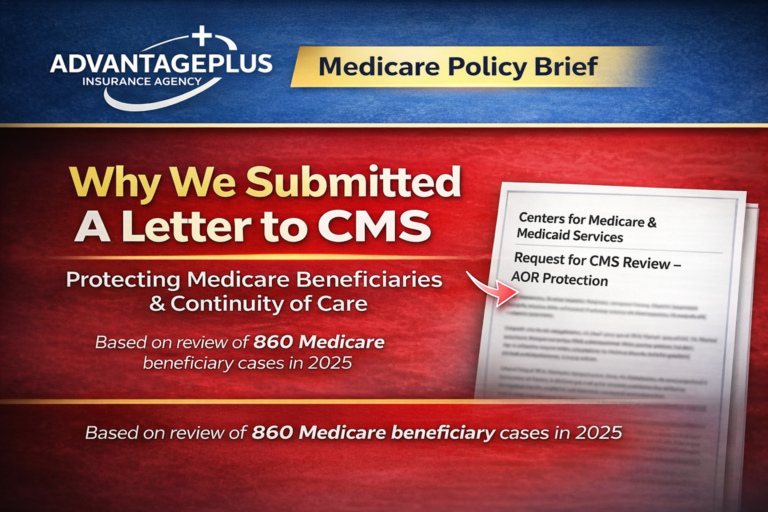
Many agents and agencies are now pushing for standardized CMS safeguards that would preserve the original Agent of Record during short term reinstatement situations involving the same plan. The proposed concept is relatively simple. If a beneficiary returns to the same plan within a protected timeframe, the original AOR should remain intact unless the beneficiary explicitly requests otherwise.
Supporters argue such a safeguard would not only protect agents, but would also discourage enrollment manipulation and reduce harmful disruptions for seniors.
Critics of the current system argue that without reform, the industry risks creating incentives that indirectly reward short term churn, unauthorized enrollments, and backend reassignment practices that undermine both trust and transparency.
The conversation is no longer staying behind closed doors.
Agents are beginning to publicly question which organizations are genuinely broker focused and which ones simply market the image effectively while operational realities tell a different story. Conferences, online forums, compliance discussions, and industry coalitions are increasingly filled with conversations about AOR integrity, reinstatement abuse, and beneficiary protection failures.
At its core, this debate is about credibility.
Because a carrier cannot truly claim to be broker friendly while benefiting from systems that allow compliant brokers to lose long standing client relationships through short term enrollment disruptions that harm beneficiaries in the process.
The Medicare industry is built on trust. Beneficiaries trust agents to guide them through some of the most important healthcare decisions of their lives. Agents trust carriers to honor compliant relationships and maintain integrity within the enrollment process.
When those relationships become vulnerable to backend administrative loopholes, the entire foundation begins to weaken.
The Medicare market has evolved dramatically over the last decade. Competition has intensified. Marketing budgets have exploded. Third party distribution has expanded rapidly. Enrollment pressure has increased across every level of the industry.
But as growth accelerates, the industry must decide what kind of system it ultimately wants to become.
One built on sustainable relationships, transparency, and beneficiary protection.
Or one where membership numbers matter more than the people behind them.
Your Next Level Starts Here
Ready To Grow Your Medicare Business The Right Way?
Join Advantage Plus and plug into a system built for serious Medicare agents. Get access to top-tier contracts, daily training, real compliance support, and a platform designed to help you grow your book the right way without giving up control of your business.
Book a Demo