

Protecting Medicare Beneficiaries: Why Short-Term Disenrollments and Unauthorized Agent of Record Changes Demand Immediate Reform
The Medicare program was designed to provide stability, continuity of care, and access to healthcare services for millions of older adults and individuals with disabilities. Yet in recent years, a growing number of Medicare beneficiaries, agents, providers, and advocacy organizations have raised concerns about practices that undermine those very principles. Among the most troubling issues are short-term disenrollments and unauthorized Agent of Record (AOR) changes.
While many health plans publicly state their commitment to member satisfaction and regulatory compliance, too often these situations are dismissed as isolated incidents, processing mistakes, or system errors when brought to light. Unfortunately, the impact on beneficiaries extends far beyond a simple administrative correction. These events can disrupt healthcare access, create confusion, damage long-standing relationships, increase costs throughout the healthcare system, and erode trust in the Medicare program itself.
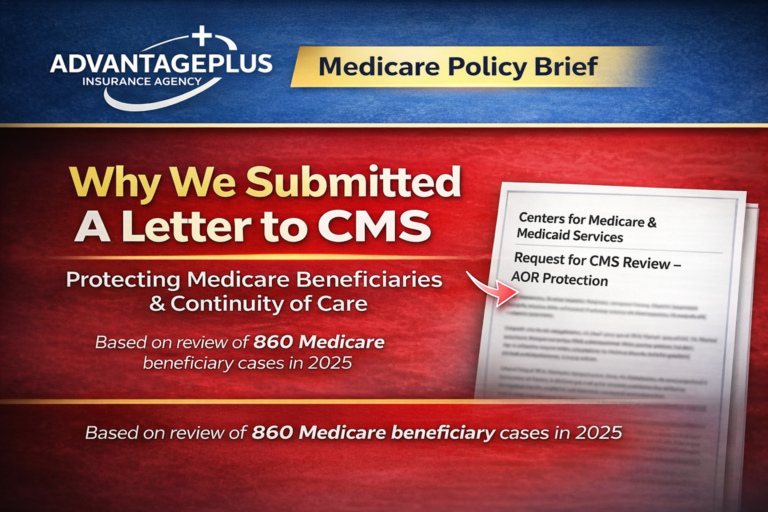
At Advantage Plus Insurance Agency, we believe Medicare beneficiaries deserve stronger protections, greater transparency, and meaningful safeguards to prevent these issues before they occur. That belief led us to formally submit recommendations to the Centers for Medicare & Medicaid Services (CMS) calling for reforms designed to protect consumers while improving accountability across the industry.
Understanding Short-Term Disenrollments
A short-term disenrollment occurs when a Medicare beneficiary is removed from a health plan, often due to an enrollment transaction, plan change, agent action, or administrative event, only to return to the same plan shortly afterward.
On paper, these situations may appear insignificant because the member ultimately ends up back where they started. However, for the beneficiary, the experience can be anything but minor.
Many seniors are unaware that their coverage has changed until they attempt to access healthcare services, fill a prescription, visit a physician, or receive a notice in the mail. In some cases, members discover the issue only after being told by a provider that they are no longer active in the plan.
Even when coverage is restored, beneficiaries may experience anxiety, confusion, delays in care, concerns about prescription access, and uncertainty about whether their healthcare providers remain available to them.
The Medicare population often includes individuals managing multiple chronic conditions, cognitive impairments, language barriers, transportation challenges, and limited access to technology. For these individuals, even a temporary disruption can have meaningful consequences.
The Hidden Burden on Healthcare Providers
When a short-term disenrollment occurs, healthcare providers frequently become the first point of contact for confused beneficiaries.
Medical offices must spend additional time verifying eligibility, contacting health plans, rescheduling appointments, correcting records, and addressing billing issues. Staff members often find themselves attempting to explain enrollment changes they had no role in creating.
For providers operating under value-based care arrangements, these disruptions can also interfere with care coordination efforts. Preventive screenings may be delayed. Follow-up appointments may be postponed. Medication management may become more difficult. Continuity of care can suffer.
What appears to be a simple enrollment transaction can create a ripple effect that impacts physicians, specialists, hospitals, pharmacies, and care coordinators throughout the healthcare system.
Increased Administrative Costs Across the System
Every unnecessary disenrollment generates administrative expenses.
Health plans must process enrollment changes, generate notices, answer member inquiries, investigate complaints, and manage reinstatement requests. Provider offices devote staff resources to resolving eligibility questions. Agents spend hours helping confused clients navigate situations they often did not create.
CMS itself must dedicate resources to oversight, complaint investigations, appeals, and enforcement activities.
When multiplied across thousands of beneficiaries nationwide, the cumulative administrative burden becomes significant.
Ironically, many of these costs could be avoided through stronger safeguards designed to prevent inappropriate disenrollments from occurring in the first place.
Do Short-Term Disenrollments Affect Health Plans?
Health plans often argue that short-term disenrollments have limited impact because the member eventually returns. While that may be technically true in certain reporting categories, the broader reality is more complex.
Frequent enrollment disruptions can negatively impact member satisfaction, increase grievance volumes, create operational inefficiencies, and generate regulatory scrutiny. Plans may also experience higher customer service costs due to increased call volumes and complaint investigations.
More importantly, even if a short-term disenrollment does not immediately affect a specific financial metric, it can damage member trust and create long-term reputational risks.
Beneficiaries expect stability. When that expectation is violated, confidence in both the health plan and the Medicare system can suffer.
The Growing Problem of Unauthorized Agent of Record Changes
Perhaps even more concerning than short-term disenrollments is the issue of unauthorized Agent of Record changes.
The Agent of Record serves as the beneficiary’s primary advocate and trusted advisor. The relationship often develops over many years and includes annual plan reviews, assistance with claims issues, provider network questions, prescription coverage concerns, and ongoing support throughout the member’s Medicare journey.
When an Agent of Record is changed without the beneficiary’s knowledge or informed consent, that relationship can be abruptly disrupted.
Many beneficiaries are unaware that a change has occurred until they attempt to contact their trusted advisor and discover that another individual has been assigned to their account.
In some cases, beneficiaries report never speaking with the newly assigned agent. Others indicate they believed they were requesting information or assistance and had no intention of replacing their existing representative.
The result is confusion, frustration, and a breakdown of trust.
The Industry Response: “System Errors”
One of the most frustrating aspects of these situations is the frequency with which health plans attribute them to administrative mistakes, technology issues, processing errors, or system limitations.
While genuine errors can occur in any organization, repeated patterns of unauthorized changes raise legitimate questions about whether existing safeguards are sufficient.
When beneficiaries lose access to their trusted representative, when agents lose years of client relationships without authorization, and when complaints continue to surface across multiple organizations, the conversation must move beyond simply labeling incidents as mistakes.
The focus should shift toward preventing the problem altogether.
Beneficiaries deserve confidence that changes affecting their healthcare coverage and representation cannot occur without clear authorization and verification.
The Impact on Medicare Beneficiaries
Unauthorized Agent of Record changes can create significant harm for Medicare beneficiaries.
Many seniors depend on their agents to explain plan benefits, resolve service issues, identify network providers, assist with prior authorization concerns, and answer questions throughout the year.
When that relationship is disrupted, beneficiaries often lose access to someone who understands their healthcare needs, prescription requirements, provider preferences, and financial considerations.
The consequences may include delayed assistance, reduced access to advocacy, confusion regarding coverage options, and decreased confidence in the Medicare enrollment process.
At its core, the issue is not merely about commissions or agent assignments. It is about preserving a beneficiary’s right to choose who represents them and ensuring that choice is respected.
The Safeguards Proposed to CMS
Recognizing the growing concerns surrounding both short-term disenrollments and unauthorized Agent of Record changes, Advantage Plus Insurance Agency submitted formal recommendations to CMS advocating for stronger consumer protections.
Among the safeguards proposed are enhanced verification requirements before enrollment transactions can trigger disenrollment activity, improved documentation standards, stronger audit trails, increased transparency regarding Agent of Record changes, and additional beneficiary notification requirements.
We have also advocated for measures that would require clear evidence of consumer intent before an Agent of Record change is processed.
Beneficiaries should receive timely notifications when significant account changes occur. They should have meaningful opportunities to dispute unauthorized actions. Health plans should be required to maintain documentation demonstrating informed consent when changes affect representation or enrollment status.
Most importantly, accountability mechanisms should be strengthened to ensure that recurring issues are identified and addressed rather than repeatedly attributed to administrative mistakes.
A Better Path Forward
The overwhelming majority of Medicare agents, health plans, providers, and industry professionals work diligently to serve beneficiaries with integrity. However, even isolated weaknesses within the enrollment and representation process can create significant harm when left unaddressed.
The Medicare system functions best when beneficiaries have confidence that their coverage will remain stable, their healthcare relationships will be protected, and their chosen representative cannot be replaced without their knowledge and consent.
Short-term disenrollments and unauthorized Agent of Record changes undermine those principles.
Protecting beneficiaries requires more than correcting problems after they occur. It requires proactive safeguards that prevent improper actions from happening in the first place.
As advocates for Medicare beneficiaries and the agents who serve them, Advantage Plus Insurance Agency remains committed to working with CMS, policymakers, health plans, providers, and industry stakeholders to strengthen consumer protections, improve accountability, and preserve beneficiary choice.
The future of Medicare should be built on transparency, trust, and informed consent. Every beneficiary deserves nothing less.
Ready To Grow Your Medicare Business The Right Way?
Join Advantage Plus and plug into a system built for serious Medicare agents with contracts, training, compliance support, marketing resources, and tools to grow the right way.