

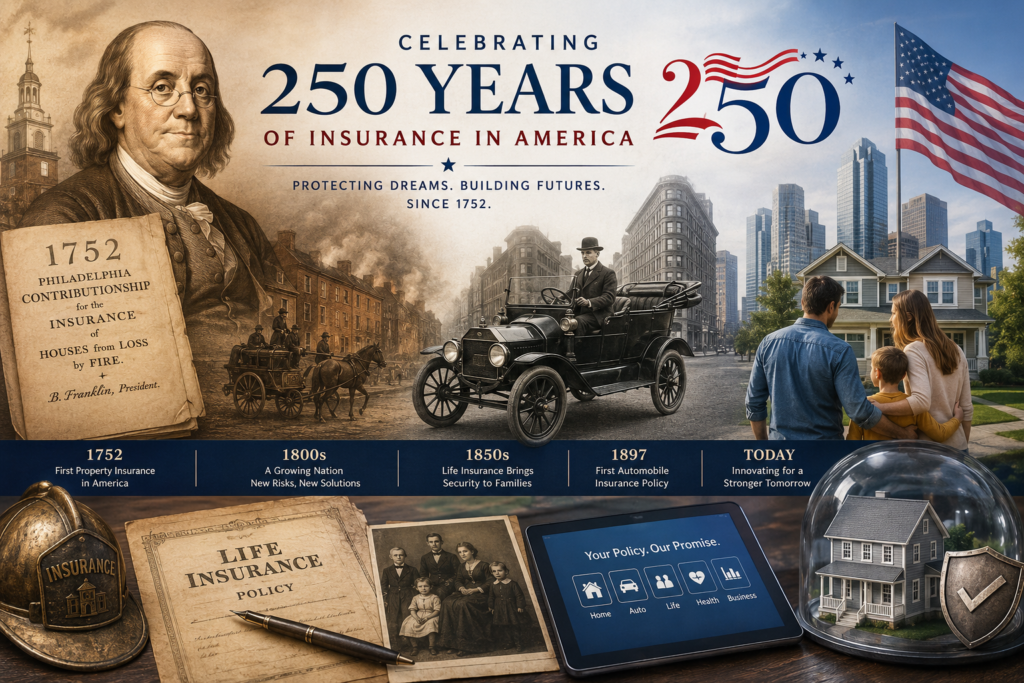
Celebrating America’s 250th Anniversary: The Remarkable History of Insurance in the United States
As America celebrates its 250th anniversary this Independence Day, conversations across the country naturally turn to the vision, courage, and leadership of the Founding Fathers. We remember the signing of the Declaration of Independence, the sacrifices made for freedom, and the extraordinary journey that transformed thirteen colonies into one of the world’s most influential nations.
Yet behind the stories of revolution, innovation, and economic growth lies another American success story that rarely receives the recognition it deserves. It is the story of insurance.
For nearly as long as the United States has existed, insurance has quietly served as one of the foundations of American prosperity. While it rarely makes headlines, insurance has protected families after devastating fires, helped businesses rebuild following disasters, supported farmers during difficult seasons, safeguarded retirement dreams, and provided millions of Americans with the confidence to pursue opportunity without fearing that a single unexpected event would destroy everything they had worked so hard to build.
Insurance has never simply been about policies or premiums. At its core, it has always been about protecting people.
The Early Years of American Protection
Long before the modern insurance companies we know today, early American communities understood that unexpected losses could threaten entire families and neighborhoods.
Colonial America was built largely from wood. Homes, churches, businesses, and warehouses stood close together, making fire one of the greatest dangers people faced. A single spark could erase decades of hard work within hours.
Few individuals had the financial resources to recover from catastrophic losses on their own. Communities often relied upon neighbors to help rebuild after disasters, but as cities grew larger, informal assistance alone could no longer meet the need.
This challenge helped inspire one of America’s earliest organized insurance efforts.
Benjamin Franklin’s Vision Changed Everything
Few people realize that one of America’s most celebrated Founding Fathers also became one of the pioneers of the American insurance industry.
In 1752, Benjamin Franklin helped establish the Philadelphia Contributionship for the Insurance of Houses from Loss by Fire, widely recognized as America’s first successful property insurance company.
Franklin understood something that still defines insurance today. When many people contribute a small amount into a shared fund, that fund can help the unfortunate few who experience unexpected losses.
His organization also introduced another revolutionary idea that continues to influence the industry more than 270 years later.
Rather than simply paying claims after fires occurred, Franklin believed that preventing losses was equally important.
Homes were inspected before coverage was offered. Buildings that presented unusually high fire risks could be declined until improvements were made. Chimney maintenance, safer construction techniques, and improved fire prevention became part of the conversation.
In many ways, Franklin helped establish the modern philosophy that insurance should not only help people recover from disasters but also encourage practices that reduce the likelihood of those disasters occurring in the first place.
That concept remains central to today’s insurance industry.
A Nation Growing Alongside Its Insurance Industry
As America expanded westward during the late eighteenth and nineteenth centuries, the insurance industry evolved alongside it.
New cities emerged. Railroads connected distant communities. Manufacturing flourished. Commerce expanded at an unprecedented pace.
Every new opportunity also introduced new risks.
Businesses needed protection for factories and warehouses. Merchants required coverage for goods traveling across the country. Farmers wanted protection against weather related losses. Families sought financial security as they accumulated homes, property, and savings.
Insurance adapted continuously to meet these changing needs.
Companies developed specialized policies that reflected America’s growing economy, helping entrepreneurs take calculated risks while providing the financial stability necessary for continued investment and expansion.
Many historians credit this protection as one of the often overlooked factors that helped fuel American economic growth during the nineteenth century.
Life Insurance Brought Financial Security to Families
As the country matured, another important form of protection gained momentum.
Life insurance offered something profoundly meaningful.
It provided families with hope during life’s most difficult moments.
For generations, many households depended entirely upon a single income earner. The unexpected loss of a parent or spouse often created immediate financial hardship.
Life insurance helped change that reality.
Instead of leaving surviving family members with overwhelming financial uncertainty, policies could provide income replacement, pay off debts, preserve homes, finance children’s education, and create financial stability during periods of grief.
This represented a significant shift in American financial planning.
Families began thinking not only about today’s needs but also about protecting tomorrow.
That philosophy continues to guide millions of Americans today.
Industrial America Created New Challenges
The Industrial Revolution transformed nearly every aspect of American life.
Factories multiplied. Construction accelerated. Railroads expanded. Workers entered new occupations with greater risks than previous generations had experienced.
Insurance evolved once again.
Employers increasingly recognized the importance of protecting businesses against liability while workers sought financial safeguards for themselves and their families.
The industry responded with new products addressing workplace risks, commercial operations, transportation, and professional responsibilities.
Each generation brought new innovations because each generation faced new challenges.
The Automobile Revolution Changed Insurance Forever
Few inventions reshaped America more dramatically than the automobile.
As motor vehicles became increasingly common during the late nineteenth century, they transformed transportation, commerce, and daily life.
They also introduced entirely new risks.
One of the earliest automobile insurance policies in the United States was issued in 1897.
At the time, automobiles were still considered remarkable inventions rather than everyday necessities.
Yet visionary insurance professionals recognized that new technology required new forms of protection.
As vehicle ownership expanded throughout the twentieth century, automobile insurance became an essential part of American life.
Today, millions of drivers rely upon auto insurance not only to satisfy legal requirements but to protect themselves, their passengers, and others sharing the road.
It is difficult to imagine modern transportation without it.
Insurance During America’s Greatest Challenges
Throughout American history, insurance has repeatedly demonstrated its importance during periods of extraordinary hardship.
Communities devastated by hurricanes, tornadoes, earthquakes, floods, and wildfires have relied upon insurance to begin rebuilding.
Businesses damaged by unexpected disasters have reopened because insurance provided financial support.
Families facing medical emergencies have depended upon health coverage to access necessary care.
Retirees have enjoyed greater financial confidence through annuities and retirement planning solutions.
Each generation has faced its own unique obstacles, and each generation has benefited from the financial resilience that insurance helps provide.
While insurance cannot prevent tragedy, it often becomes one of the first steps toward recovery.
The Modern Insurance Industry
Today’s insurance industry is remarkably different from the one Benjamin Franklin helped establish more than two centuries ago.
Technology has transformed underwriting, claims processing, customer service, and risk analysis.
Artificial intelligence assists insurers in identifying trends and improving efficiency. Mobile applications allow policyholders to access information instantly. Digital claims processing enables faster recovery following many losses.
Despite these technological advances, the industry’s core purpose remains unchanged.
Insurance continues to bring people together through the shared principle that many can help protect the few.
It remains one of society’s most powerful examples of collective responsibility.
More Than a Business
Insurance is often viewed simply as a financial product.
In reality, it represents something much more meaningful.
It allows entrepreneurs to launch businesses with greater confidence.
It helps parents protect their children’s future.
It supports homeowners rebuilding after devastating losses.
It gives retirees greater financial certainty.
It enables healthcare providers to focus on patient care.
It protects first responders, contractors, manufacturers, transportation companies, nonprofit organizations, and countless other individuals whose work strengthens American communities every day.
Insurance quietly supports nearly every sector of the American economy.
Most people never think about it until they need it.
That is perhaps its greatest success.
Looking Toward America’s Next 250 Years
As the United States enters its next chapter, new risks will undoubtedly emerge.
Cybersecurity, artificial intelligence, autonomous vehicles, climate related challenges, evolving healthcare needs, and changing economic conditions will continue to shape the future.
Just as insurance adapted during the Revolutionary era, the Industrial Revolution, the automobile age, and the digital transformation, it will continue evolving to meet the needs of future generations.
Innovation has always been part of the industry’s DNA.
So has resilience.
A Legacy Worth Celebrating
This Independence Day, as Americans celebrate 250 years of freedom, innovation, and opportunity, it is worth remembering the quiet institutions that helped make that progress possible.
From Benjamin Franklin’s vision in 1752 to today’s sophisticated insurance marketplace, the industry has stood beside American families through moments of celebration, uncertainty, hardship, and recovery.
Insurance rarely seeks recognition.
Its greatest achievements are often measured not by headlines, but by homes rebuilt after devastating fires, businesses reopened after disasters, families protected during life’s most difficult moments, and dreams preserved despite unexpected setbacks.
For more than two and a half centuries, insurance has reflected one of America’s greatest strengths: the belief that communities become stronger when people help protect one another.
As our nation celebrates its 250th birthday, that enduring principle deserves recognition alongside the remarkable history of the United States itself.
Happy 250th Birthday, America. Here’s to the people, the resilience, the innovation, and the enduring promise of protecting one another for generations to come.
Ready To Grow Your Medicare Business The Right Way?
Join Advantage Plus and plug into a system built for serious Medicare agents with contracts, training, compliance support, marketing resources, and tools to grow the right way.